 Singapore
 Malaysia


Your shopping cart is currently empty. Start adding products to your cart!


Your enqury cart is currently empty. Start adding products to your cart!
Summary:
Running out of warehouse space is rarely a space problem. Most facilities have sufficient floor area; the issue is how much of it is surrendered to access aisles, and how much working time is absorbed by moving people to inventory rather than moving inventory to people.
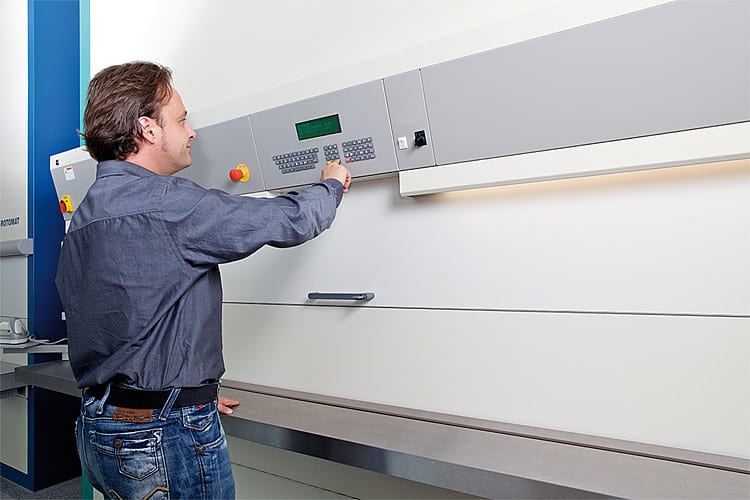
A vertical storage carousel is an automated system that rotates stored inventory to a fixed operator access point on demand. This eliminates aisle travel and compresses storage into a fraction of the floor space conventional racking requires.
That distinction changes what the return on investment actually looks like.
Static racking is familiar, and that familiarity can make its costs easy to overlook.
The costs that accumulate most quietly are:
Hidden Cost | What It Means in Practice |
Aisle space as dead space | Access aisles can account for 50% or more of total floor area, storing nothing and generating no value. |
Labour time lost to travel | In high-SKU or dispersed layouts, travel time per pick absorbs a measurable share of every shift. |
Picking errors and their downstream costs | Manual retrieval is prone to misidentification and mispicking, generating returns, rework, and customer service overhead. |
Inventory shrinkage and unauthorised access | Open shelving offers limited access control, making high-value or compliance-sensitive items difficult to secure without additional infrastructure. |
Compliance and audit risk | Facilities in regulated industries (aerospace, medical, pharmaceuticals) face audit exposure when inventory handling cannot be traced systematically. |
Underutilised vertical space | Most static racking tops out well below a facility’s ceiling clearance, leaving paid-for cubic metres above the top shelf unused. |
Understanding the cost structure of a vertical storage carousel requires looking beyond the purchase price. Installation, integration, and long-term operating costs all factor in.
Cost Component | What It Covers | Typical Considerations |
System acquisition | Unit price based on carrier configuration, capacity, and model | Varies by inventory type, load requirements, and access openings |
Installation and commissioning | Physical installation, structural assessment, cabling, and system testing | Ceiling clearance and floor load capacity are key variables |
Warehouse management system (WMS) integration | Software connectivity for automated pick lists, inventory tracking, and reporting | Standard API connectivity is common; custom integration adds cost |
Operator training | Time required to train staff on system use and maintenance | Carousel systems generally have a short learning curve |
Ongoing maintenance | Scheduled servicing, parts replacement, and remote diagnostics | ISO-certified systems typically include structured service agreements |
Space savings offset | Reduction in leased floor area, racking hardware, and aisle infrastructure | Quantifiable against current lease cost per square metre |
Labour cost reduction | Fewer pick hours per shift due to goods-to-person retrieval | Measurable against pre-installation pick rate benchmarks |
Operational savings accumulate over time and often offset the capital outlay within a defined payback period. The exact timeline varies by facility size, inventory profile, and usage intensity. A structured consultation is a more reliable starting point than a generic payback estimate.
When those hidden costs begin compounding faster than operational adjustments can absorb them, the case for switching becomes clear. And the returns are rarely limited to the cost lines you have already identified.
Space reclamation is the most visible return from vertical carousel storage, but it is rarely the most financially significant. Facilities that have made the switch report gains across several other dimensions:
Taken together, these returns extend well beyond floor space in ways a simple space-saving calculation does not capture.
Realising those returns depends on choosing the right system. Not every facility is the right fit for a carousel, and a structured evaluation is the most reliable way to determine whether the returns justify the investment.
WMS integration is one of the most consequential variables: it determines whether the system can automate pick lists, generate audit trails, and feed inventory data back into your operations.
The 5 factors below are the most consequential in determining suitability:
Evaluation Factor | What to Assess | Why It Matters |
Inventory type | Are items uniform in size and weight, or highly variable? | Carousels perform best with uniform, lightweight inventory; variable or heavy loads may suit a VLM better. |
Retrieval frequency | How many picks per hour or shift does your operation require? | High-frequency, repetitive retrieval is where carousel systems deliver the strongest throughput gains. |
Ceiling clearance | What is the usable height of your facility? | Carousel systems are well-suited to lower ceiling environments where a VLM would not fit. |
WMS integration | Does your operation use a warehouse management system? | Integration unlocks pick-list automation, inventory reporting, and audit trails; without it, gains are limited to space and basic workflow improvements. |
Total cost of ownership | What is your target payback period and how is ROI defined internally? | A TCO assessment across 5 to 10 years gives a truer picture of value than the purchase price in isolation. |
The right answer depends on your facility’s specifics, not any single factor in isolation. Once the key variables are mapped, matching them to the right system becomes considerably more straightforward.
The Hänel Rotomat range is built around the operational profiles described above, with configurations suited to both compact workshop environments and larger industrial settings.
TYT Corporation supplies Hänel automated storage systems that serve industrial, logistics, and commercial settings across Singapore and the wider region. Applications range from tool cribs and workshop parts storage to document archives and medical supply management.
The core Rotomat systems available, along with their operational focus, are summarised below:
System | Operational Focus | Typical Environments | Key Strength |
Hänel Rotomat Industrial Carousel | Compact, predictable inventory workflows for parts and tools | Workshops, tool cribs, manufacturing, automotive | Configurable carriers with variable dividers and inserts; ESD-safe storage available for sensitive components |
Hänel Rotomat Office Carousel | Document and file retrieval for administrative settings | Legal offices, medical records, government archives | PC-controlled retrieval with indexed access; lockable sliding doors for dust-free, secure storage |
TYT Corporation also supports broader automated storage and retrieval system (ASRS) needs through the following solutions:
System | Application | Operational Fit |
Hänel Lean-Lift Vertical Lift Module | High-density, variable inventory storage using full ceiling height | Manufacturing, automotive, electronics, and logistics; handles loads up to 1,000 kg per tray with potential floor space savings exceeding 60% |
Remmert ASRS | Long and sheet material storage, including the BASIC Tower and MIDI modular system | Heavy industrial environments handling flat goods and oversized stock |
iCUBE Flexible and Scalable Warehouse Automation | High-throughput pallet automation using 3D-Carriers, lifts, and Warehouse Control Software | Distribution and fulfilment operations needing scalable, forklift-free automation with ERP integration |
For facilities moving away from static racking, the Rotomat Industrial Carousel and the Hänel Lean-Lift VLM are the 2 most common starting points. TYT Corporation’s consultation process works through your inventory profile, ceiling clearance, and throughput requirements to identify the strongest fit.
Transitioning to a vertical carousel system is a structured process. Approaching it in sequence reduces disruption:
Working through these steps gives you a clearer brief, more accurate cost expectations, and a stronger position when evaluating system proposals.
TYT Corporation, the sole authorised Hänel distributor in Singapore, brings over 35 years of experience delivering automated storage solutions across industrial, logistics, and commercial environments.
Our team supports the full process: facility audit, system selection, installation, and post-deployment review, covering the Hänel Rotomat carousel range alongside the Hänel Lean-Lift VLM, Remmert ASRS, and iCUBE flexible warehouse automation systems.
Contact us today to book a facility assessment and identify which vertical storage carousel or ASRS configuration will deliver the strongest return for your operation.