 Singapore
 Malaysia


Your shopping cart is currently empty. Start adding products to your cart!


Your enqury cart is currently empty. Start adding products to your cart!
Summary:
Find out what impacts the true cost and value of vertical lift modules for advanced industries in 2026. Learn the essential cost influencers, ROI formulas, and rapid payback drivers unique to automated storage investments. This guide can help you select the right automation for your facility, minimise costly errors, and stay ahead of evolving compliance requirements.
In 2026, companies across Southeast Asia face new challenges in handling sensitive, high-value inventory from automotive and electronics to advanced manufacturing.
Compliance demands, labour shortages, and the need for flawless traceability now make automation essential. Facilities seeking greater accuracy, speed, and cost savings are turning to vertical lift modules (VLMs) to raise standards and meet strict industry expectations.
This guide breaks down the cost components, technical considerations, and ROI levers you will need to assess before investing in a VLM. If your organisation aims to streamline production, safeguard inventory, and automate accuracy, all while navigating rising compliance and labour demands, understanding these insights is essential.
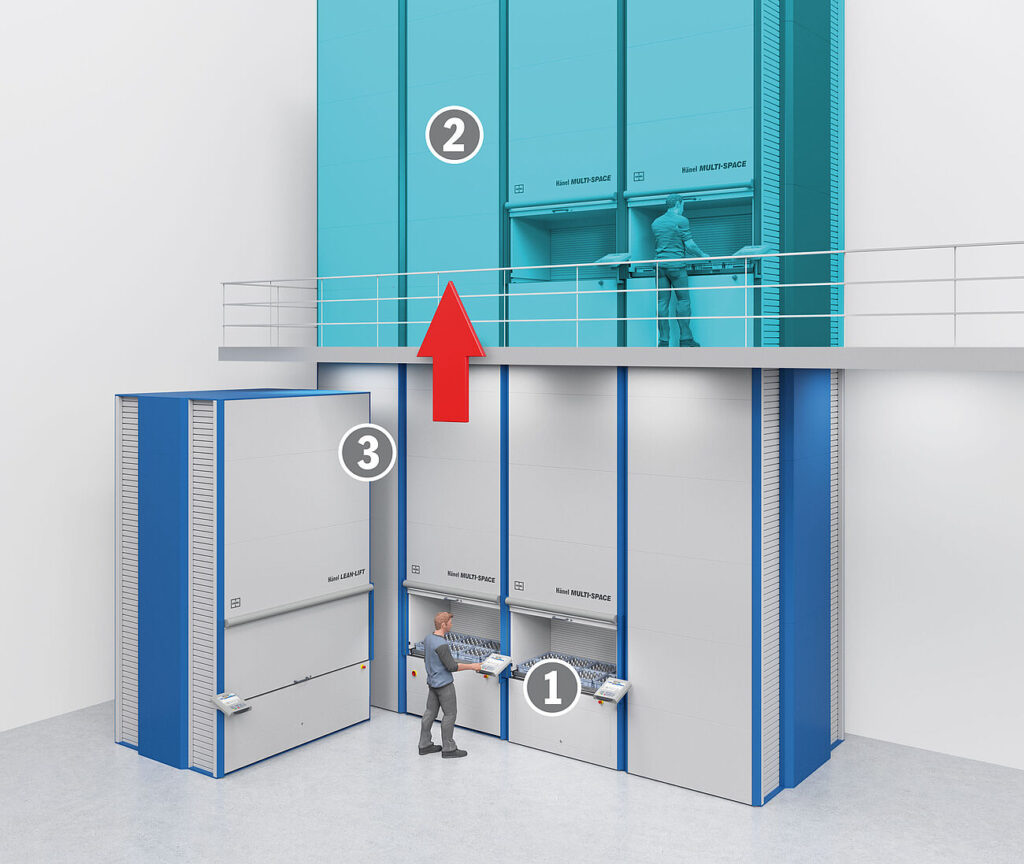
A vertical lift module is an advanced storage and retrieval system that automatically delivers requested items, such as parts, electronics, or tools, directly to the operator. Controlled by intuitive software, VLMs enhance inventory security, tracking, and accessibility at every stage of the workflow.
For example, in electronics environments, anti-static trays with ISO-compliant controls help safeguard sensitive components and support audit requirements. In manufacturing, vertical lift modules enable organised and reliable access to high-value items, reducing manual searches and supporting process efficiency.
Success with the vertical lift module system starts by understanding the true drivers of cost, both upfront and over time.
With increased regulatory oversight and demand for instant inventory reporting, investments in automation are increasingly justified by improved traceability, lower per-shipment costs, and greater transparency. Key factors include:
One of the main factors influencing the cost of a vertical lift storage system is its physical dimensions and how you choose to configure the system for your specific application.
|
Configuration Option |
Typical Variations |
Influence on Cost |
|
Module Height |
Low, standard, |
Taller units allow more storage but increase equipment cost |
|
Tray Capacity |
Light, medium, heavy-duty |
Higher-capacity trays use stronger materials and add to price |
|
Tray Customisation |
Dividers, |
Specialised trays or anti-static features result in a higher cost |
|
Number of Trays |
Depends on height/ configuration |
More trays increase storage and overall system investment |
Choose system options that fit your storage profile. This maximises return on investment and avoids unnecessary costs. Selecting the right trays and payloads also supports compliance and keeps sensitive items protected, while making the most of your available space.
VLMs with integrated software for inventory control and real-time access deliver clear benefits wherever workflows demand speed and accuracy. More complex integrations, like ERP system links or operator authentication, may add to initial and ongoing costs.
These same integrations, however, are precisely what enable the instant inventory reporting and traceability that regulators and auditors increasingly expect.
Therefore, evaluating which integrations your operation genuinely requires ensures you invest in capability that delivers measurable returns, rather than complexity for its own sake.
Installation and customisation requirements vary significantly depending on your facility and workflow, and understanding these variables upfront helps avoid budget surprises.
A thorough site assessment lays the groundwork for vertical lift module system installation. Tailor your system based on workflow mapping and any needs for cleanroom or ESD handling.
Selecting the right vertical lift module system provider is just as important as selecting the right system. The best vertical lift module investments are underpinned by a provider who understands your operational environment, stands behind their equipment with local expertise, and supports you well beyond installation. Here is what to prioritise.
Partnering with local providers ensures system assembly, commissioning, and all related safety documentation are in line with Singapore’s regulatory framework, facilitating seamless handover and ease of future expansion.
Providers offering clear, line-itemed quotations and standing behind local support, quick spare-part access, and documented safety compliance help clients plan budgets confidently, with no hidden lifecycle costs.
Maintaining continuous, reliable operation is vital for industries dependent on timely, accurate materials handling. Choosing a vertical lift module provider offering regular maintenance and responsive support reduces downtime and extends system life, protecting your investment and ensuring consistent workflow.
Evaluate your automation roadmap — schedule a consultation to benchmark your facility’s needs and discover practical ways to capture early ROI from automated storage.
Before making any investment, it’s essential to look beyond upfront prices and consider the broader impact on your operation’s efficiency, accuracy, and bottom-line results.
Understanding the core value drivers behind a vertical lift module will help you quantify expected returns and determine the true payback period.
Evaluate these variables:
Calculation example:
These core advantages underpin the rapid return that vertical lift modules bring to modern facilities:
Recognising how these gains translate into measurable payback is essential for evaluating your investment timeline in 2026.
The combination of greater inventory control, faster throughput, and fewer errors means many businesses realise significant gains soon after deploying a VLM. These operational improvements often contribute to a rapid payback period, sometimes within 2 years, especially where manual handling costs or inventory losses were previously high.
A strong ROI depends on selecting a vertical lift module configured around your real-world part mix, throughput demands, and compliance obligations.
Evaluate:
A tailored vertical lift module system not only automates storage but also ties digital processes, personnel safety, and inventory accountability together, ready to adapt as your production volumes and regulatory standards change.
TYT Corporation offers 2 proven automated storage systems to match your operational scale and compliance requirements.
|
Solution |
Best For |
Key Strengths |
|
Electronics, automotive, ESD-sensitive environments |
Vertical space optimisation, anti-static trays, ISO-compliant access control, fast goods-to-person retrieval |
|
|
Small components storage, High-speed order picking |
Delivers fast, ergonomic, and secure automated retrieval that integrates seamlessly with existing warehouse and ERP systems |
Both systems are supported by TYT Corporation’s in-house engineering team, with local spare-part availability and ISO 9001 and Bizsafe-certified service across Singapore and Malaysia.
We also provide tailored storage solutions and round-the-clock maintenance to ensure your systems operate at peak efficiency.
With over 35 years of experience, TYT Corporation is the trusted partner in Singapore and Malaysia for advanced industries seeking secure Hänel vertical lift modules. Our in-house team handles system design, installation, and ongoing technical support, making it easy for you to get started and see real improvements fast.
Contact us today to see how advanced automation can make your inventory more accurate, your audits easier, and your materials handling more secure.