


Your shopping cart is currently empty. Start adding products to your cart!


Your enqury cart is currently empty. Start adding products to your cart!
Summary:
For many facilities, pressures are compounded by rising industrial land costs, growing labour constraints, and the need to maximise every square metre of floor space. Vertical carousel storage systems address these challenges by bringing inventory directly to the picker through automated rotation, replacing traditional shelving.
A 2025 study found that order picking accounts for 50 to 75% of total warehouse operating costs and around 55% of labour time, making it a key area for improvement.
The system rotates bins, shelves, or carriers along a fixed track to deliver items to an ergonomic picking window. This goods-to-person flow reduces worker travel, while inventory software selects the shortest rotation path to limit idle time.
Carousel systems generally fall into 3 categories:
The table below compares conventional shelving with automated carousel storage.
Feature | Conventional Shelving | Vertical Carousel Storage System |
Storage Envelope | Exposed to dust and unauthorised access | Protects items from dust and tampering |
Retrieval Method | Manual searching, walking, and climbing | Software-driven rotation to a fixed picking window |
Space Usage | Uses only the lower 2 to 3 metres of building height | Full vertical space, up to 14.5 metres |
Footprint | Long aisles needed for picker access | One unit replaces multiple metres of shelving aisles |
Carousel storage is not industry-specific, but certain operations gain more from it than others.
Also read: Space-Saving Guide: Automated Storage and Retrieval System
Carousel storage systems help warehouses improve space use, picking efficiency, accuracy, and safety without expanding the building footprint.
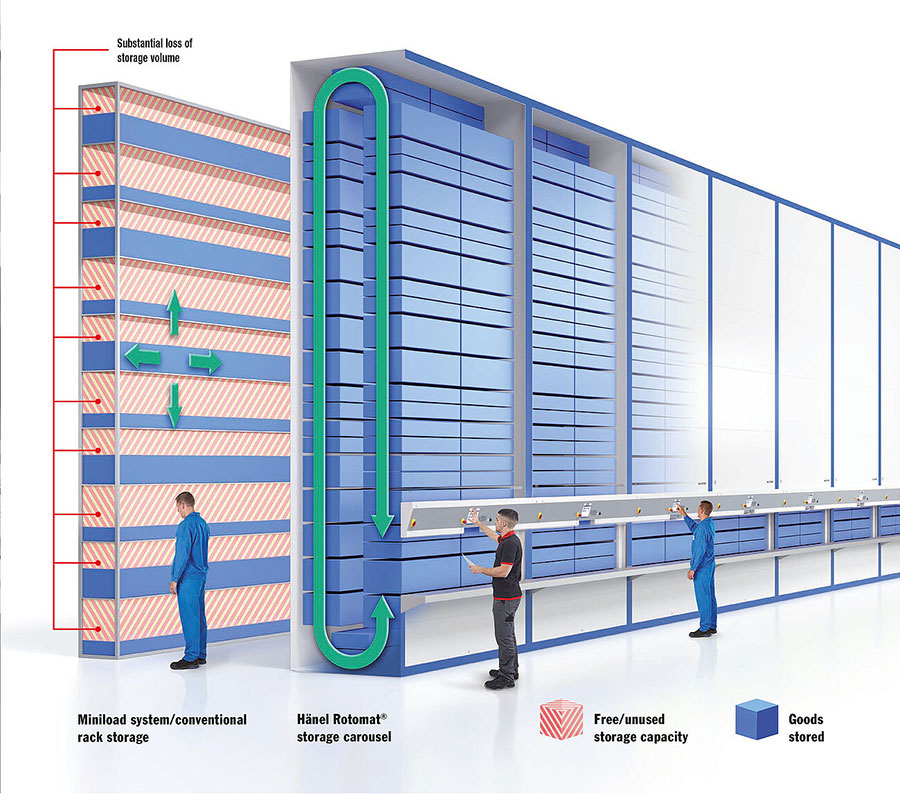
Conventional shelving uses only the lower 2 to 3 metres of a building. A vertical carousel extends storage to the full available room height, such as the Hänel Lean-Lift, which offers up to 85% more space savings on the same footprint than a miniload system or rack store.
Manual order picking typically has an error margin of 1 to 3%. Carousels combined with pick-to-light or barcode confirmation can halve the error rate. Removing ladders, step stools, and overhead reaching reduces musculoskeletal injuries, and operators stand at a fixed station rather than navigating aisles where forklifts may be working.
A vertical carousel storage system, like the Hänel Rotomat, uses a series of carriers that move up and down inside an enclosed structure, similar to a Ferris wheel motion. However, a vertical lift module (VLM) works on a different principle, using a central extractor to retrieve trays from fixed shelves on either side.
Operators request items through a control panel, connected warehouse software, barcode scan, or production instruction. Once the carrier arrives, pick-to-light bars or laser pointers indicate the exact bin to pick from, reducing search time and selection errors.
The right carousel storage system should match the physical goods, picking process, and operational targets of the warehouse.
Key features to assess include:
Not sure which carousel format suits your facility? Contact our specialists to assess your floor plan, SKU profile, and picking demands to recommend the right solution.
A carousel storage system should be planned around stock profile, picking demand, floor conditions, software requirements, and operator workflow.
The goal is to identify the small share of SKUs that drive most pick activity, since those items deliver the strongest return when moved into carousel storage.
Other practices worth following:
Successful deployment depends on accurate item data, suitable system placement, and clear operating rules. Item dimensions, weights, pick frequency, and stock levels should be checked before the design is finalised.
Practical integration steps include:
Peak demand should also be planned for. Access points, software queues, and picking routines must be sized to prevent delays.
The right carousel storage system should match the warehouse’s stock profile, picking method, safety requirements, software environment, and growth plans.
When comparing options, assess both equipment performance and provider capability. Important comparison points include:
ROI depends on how well the carousel performs after installation.
Key metrics include pick rate, error rate, stock accuracy, downtime, and storage utilisation. Ongoing support should cover operator refresher training, preventive maintenance, software updates, spare parts availability, and periodic reviews.
Also Read: 2026 ROI Guide: Vertical Lift Module Costs and Value Drivers
TYT Corporation carries the full range of Hänel Rotomat vertical carousel systems, covering both industrial and office applications. The table below outlines each model and what it is designed to store.
Model | Best For | Storage Type |
Hänel Rotomat Industrial Carousel | Warehouses, MRO stores, electronics and automotive parts | Small to medium industrial parts, bins, SMT reels, cable drums, tools |
Hänel Rotomat Office Carousels 300 | High-volume lateral filing | Lateral hanging folders |
Hänel Rotomat Office Carousels 400 | Administrative offices with large folder volumes | Lateral stand-up folders |
Hänel Rotomat Office Carousels 500 | Centralised file management | Binders and box files |
Hänel Rotomat Office Carousels 600 | Active filing with frequent access | Vertical hanging folders |
Hänel Rotomat Office Carousels 7-600 | Mixed administrative archives | Index cards and stand-up folders |
Hänel Rotomat Office Carousels 700 | Specialist archive management | Cards, microfilm, microfiche, X-ray, press photos |
Looking to save space, improve picking accuracy, and reduce manual handling?
As the sole authorised distributor of Hänel storage systems in Singapore, TYT Corporation has been helping facilities across the region deploy and maintain carousel solutions for over 35 years.
Our specialists design systems around real warehouse needs, from floor space and SKU profiles to operator workflow and long-term maintenance.
Contact us to discuss a smarter storage solution for your facility.