


Your shopping cart is currently empty. Start adding products to your cart!


Your enqury cart is currently empty. Start adding products to your cart!
Summary:
The right system depends on your operation’s primary constraint. Labour and throughput point to ASRS. Floor space and capital flexibility point to mobile racking.
ASRS delivers goods to the operator automatically, while mobile racking compresses aisles but still requires operators to travel to the goods.
ASRS costs more upfront than mobile racking, which is cheaper to install, maintain, and reconfigure.
Annual costs of mispicks, labour dependency, and fulfilment delays are the clearest indicator of whether ASRS delivers a viable return for your operation.
Many facilities deploy both systems: ASRS for high-frequency pick zones and mobile racking for bulk or seasonal inventory. The right fit depends on your primary operational constraint.
More automation is not always the right answer. With industrial land costs in Singapore continuing to rise, warehouses are under pressure to make every square metre count without necessarily committing to a full capital overhaul.
For some operations, a fully automated storage and retrieval system (ASRS) delivers a return that justifies the investment. For others, mobile racking recovers significant floor space at a fraction of the cost and outperforms ASRS on every metric that matters for that specific facility.
Neither system wins universally. The determining factor is your operation’s primary constraint: throughput and labour, floor space and capital, or both. This guide works through both systems against the criteria that determine which one fits your facility and your growth trajectory.
The most important factor is identifying your primary constraint: operational throughput, floor space, or capital flexibility. Each points to a different warehouse automation system. The most common triggers for a warehouse investment decision fall into a few distinct categories:
Selecting the wrong system does not just affect upfront spend. It compounds over time through mismatched throughput capacity, underused infrastructure, or reconfiguration costs that erode the original business case.
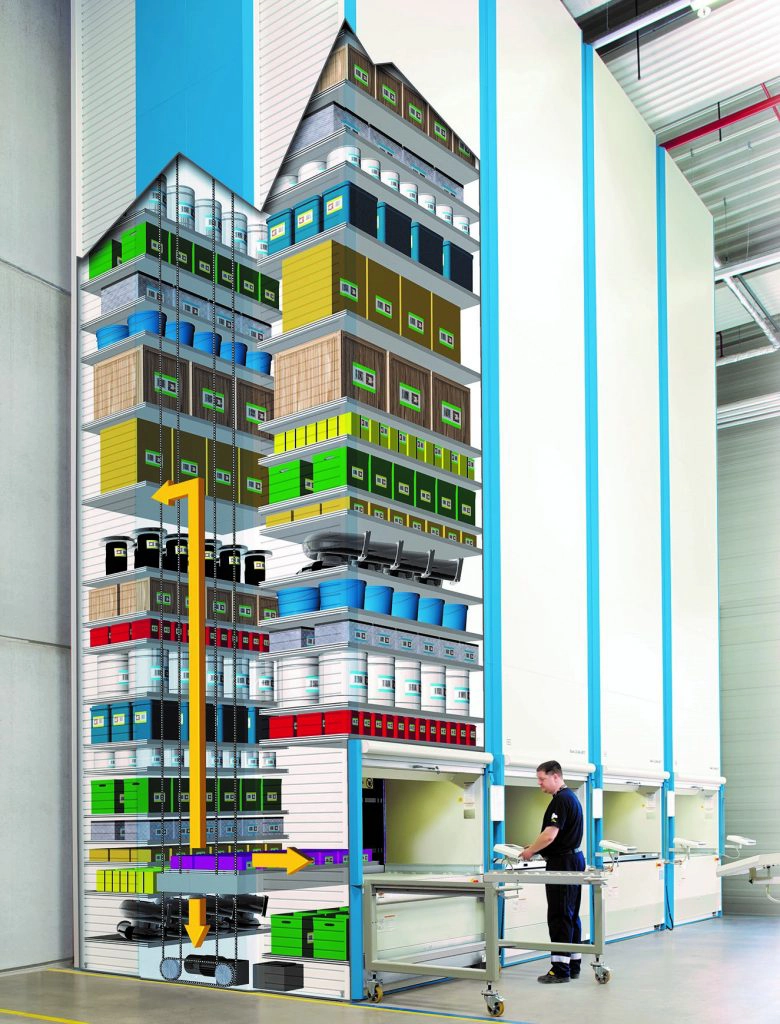
An automated storage and retrieval system is a computer-controlled solution that automatically places, stores, and retrieves goods using mechanised equipment, delivering items directly to the operator rather than requiring staff to travel to them.
Mobile racking is a high-density shelving system mounted on motorised bases that compresses aisles until access is needed, recovering significant floor space within an existing footprint.
The table below captures where the 2 systems diverge across key operational dimensions.
Feature | ASRS | Mobile Racking |
Common types | Vertical lift modules (VLMs), vertical carousels, bin-shuttle systems | Mobile pallet racking, mobile shelving, compactus systems |
Retrieval method | Goods delivered automatically to operator | Operator travels to goods; aisle opens on demand |
Primary benefit | Labour reduction, throughput speed, pick accuracy | Floor space recovery, capital flexibility |
Space efficiency | Uses full ceiling height; removes floor-level aisles | Eliminates fixed aisles; works within standard ceiling clearance |
Integration requirements | WMS, ERP, control software, structural assessment | Minimal software dependency; simpler installation |
Reconfigurability | Low to moderate; requires planning to reconfigure | High; can adapt as inventory profiles change |
Best fit | High-volume, high-SKU, labour-constrained operations | Moderate-frequency picking, seasonal or evolving inventory, cold storage |
Automated storage system addresses throughput and labour; mobile racking addresses density and capital flexibility. Your facility’s primary constraint will determine which of those matters more.
An automated storage system carries a significantly higher upfront investment, covering equipment, software, structural integration, and commissioning.
Mobile racking delivers meaningful density gains at a lower initial outlay, with simpler installation requirements and fewer integration dependencies. Total cost of ownership is the correct framework, not purchase price alone.
The table below outlines how the 2 systems compare across the ownership lifecycle.
Cost Factor | Automated Storage System | Mobile Racking |
Capital outlay | High | Moderate |
Installation complexity | High (structural, software, commissioning) | Low to moderate |
Labour savings over time | Significant and compounding | Minimal |
Maintenance | Ongoing software, mechanical, and support costs | Lower; periodic mechanical servicing |
Payback period | Typically longer; returns compound over time through labour and accuracy gains | Faster at moderate investment levels; lower ongoing maintenance costs |
Reconfiguration cost | Higher if operational needs change | Low; system can be adapted or expanded |
Before drawing any cost conclusions, map both options against your own operational data: throughput volume, current labour costs, error rates, and space utilisation. Industry-average benchmarks are a starting point, not a substitute for a facility-specific assessment.
ASRS is the right warehouse automation choice where operations face high volumes, a complex SKU (stock-keeping unit) mix, persistent labour shortages, or staff turnover. The profiles that consistently deliver include:
Well-configured automated storage system process retrieval volumes that far exceed what manual or semi-manual alternatives can sustain at scale. They also achieve near-zero mispick rates by removing human handling from the retrieval chain.
Use these annual cost indicators to build the payback case:
That combined figure is the clearest indicator of whether the investment has a viable return for your facility.
Mobile racking is the right warehouse automation choice where operations have moderate retrieval frequency, a seasonal or evolving product mix, cold storage requirements, or a preference for phased investment. The profiles that consistently deliver include:
Eliminating permanent aisles through mobile racking can recover a significant proportion of usable floor area that conventional fixed racking wastes on permanent accessways. For operations where floor space is the primary constraint, it is one of the most effective warehouse solutions available.
Reconfigurability is what operations that have deployed it highlight most consistently: the ability to adapt as inventory profiles, SKU mix, or seasonal volumes shift over the planning horizon.
TYT Corporation‘s product range covers both ASRS and racking configurations. The table below outlines each system, its type, and the operational profiles it serves.
System | Type | Best For |
Hänel Lean-Lift | Vertical lift module (ASRS) | High-SKU warehouses requiring full ceiling height utilisation; saves over 60% floor space and delivers items to an ergonomic access point |
Hänel Rotomat Industrial Carousel | Vertical carousel (ASRS) | Industrial parts, MRO stores, and electronics operations; creates up to 60% more storage capacity with goods-to-person retrieval and carriers rated up to 750 kg |
Remmert Sheet Metal Storage System | Sheet metal goods ASRS | Metal manufacturing environments storing sheet metal, and long materials. Fully automated retrieval synchronised with production and intralogistics processes. |
Remmert Storage System | Bulky and long goods ASRS | Designed to store and process high volumes of awkward, oversized, or heavy profiles, bars, pipes, and tubes. Frees up to 80% of floor space by replacing sprawling floor storage with vertical stacking. |
iCUBE | 3D-carrier pallet ASRS | High-throughput pallet storage across e-commerce and multi-sector fulfilment; scalable 3D-carrier and lift system controlled by onboard Warehouse Control Software (WCS), with forklifts eliminated from the storage area |
Racking and Shelving System | Static and mobile racking | Bulk goods, wide-span and heavy-duty loads, cold storage, and operations requiring phased investment; available in boltless, heavy-duty, medium-duty, and mobile shelving configurations |
Each system is configurable to your floor layout, ceiling clearance, and SKU profile. TYT’s specialists can also assess hybrid configurations where automated storage system and racking are deployed alongside each other.
Facilities that have matched the right system to their operational profile consistently report stronger throughput, better space utilisation, and lower running costs over time.
Many facilities deploy both systems, where each performs best: ASRS for high-frequency pick zones, mobile racking for bulk or seasonal inventory. The right configuration depends on your constraints: throughput and labour, floor space and capital, or both.
TYT Corporation has over 35 years of storage expertise across Singapore and Malaysia and is the sole authorised Hänel distributor in Singapore. Contact us today to find out which automated storage system fits your operation.