 Singapore
 Malaysia


Your shopping cart is currently empty. Start adding products to your cart!


Your enqury cart is currently empty. Start adding products to your cart!
Summary:
The real cost of manual storage is the labour, injury risk, and damaged material on every trip from rack to machine, none of it in your storage budget.
Automated storage and retrieval systems store and feed sheet metal directly to machines, freeing up costly floor space in land-tight Singapore.
To determine if ASRS is worth it for your facility, compare manual vs automated costs over 3 to 5 years across 4 factors: floor space, labour, material damage, and machine use.
The right system pays back on your own numbers, not a generic estimate. TYT matches 2 Remmert options to your volume: the compact BASIC Tower or the higher-volume MIDI.
Singapore industrial rents rose again in early 2026, and at 88.9% occupancy, the market stays tight, so the floor your storage sits on costs more every year. Moving material across that floor costs money, too, but it never shows up in the storage budget. Picture a forklift making the same trip 40 times a day: out to the rack, lift a metal sheet, over to the laser cutter, back with the offcut. Each run takes only a few minutes, but across every job, shift, and worker, those minutes add up to a real cost you are not counting.
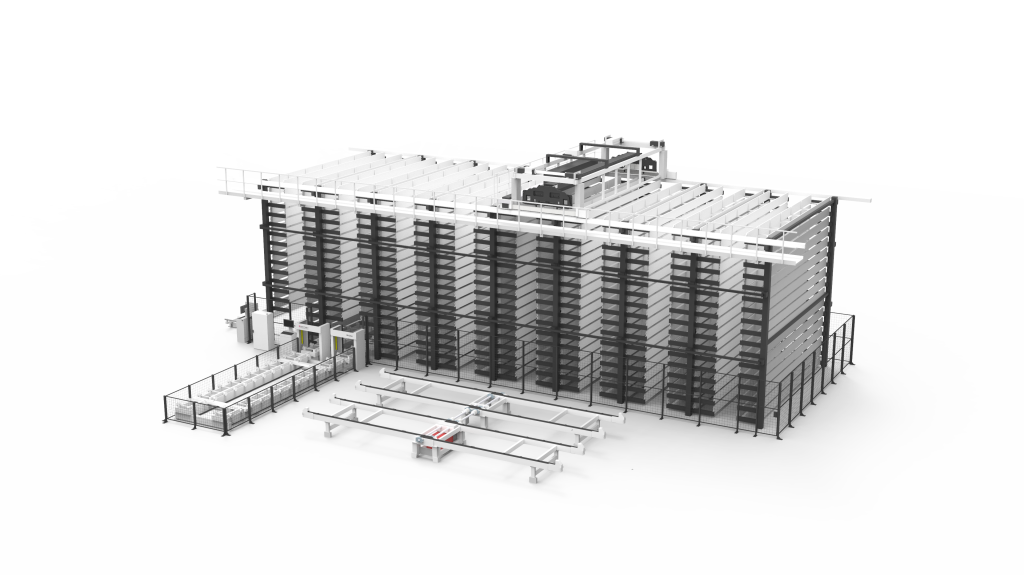
An automated storage and retrieval system in Singapore, or ASRS, removes that trip. It is not a storage cupboard but a transport system. An automated sheet metal storage system is a computer-controlled system that stores sheet metal, long goods, and workpieces, then moves them to and from connected machines in a continuous flow.
In the industrial property market, every square metre your storage occupies carries a direct cost, so a useful first step is to convert your current footprint into an annual rental value.
Manual handling carries injury exposure under Singapore’s Workplace Safety and Health Act (WSHA), and this cost rarely appears in a storage budget.
To total what your current setup actually costs, tally:
An automated storage and retrieval system in Singapore replaces the manual search, lifting, and transport steps in your material-handling process, automatically retrieving the correct sheet, profile, or workpiece. It either delivers that material to the operator at an ergonomic access point or transports it directly to a connected computer numerical control (CNC) cutting or forming machine. The manual transport journey disappears, and the connected machine is fed without the interruption a manual fetch would cause.
Warehouse space optimisation follows immediately. A vertically stacked system replaces sprawling horizontal racks with a compact, high-density footprint, freeing floor space you can repurpose for additional production capacity. In a land-constrained environment, that recovered area is a working asset rather than an afterthought.
Because the system stores materials vertically and manages cassette positions automatically, your facility no longer needs wide forklift aisles or buffer zones around material stacks. The storage volume compresses into a controlled footprint that scales with your inventory rather than against your floor plan.
To understand if an automated storage & retrieval system suits your facility in Singapore, compare manual storage costs against an automated system over a 3- to 5-year horizon. Set the running costs of your current manual setup against the total cost of ownership (TCO) of a well-specified ASRS.
The comparison rests on 4 measurable inputs:
Labour is typically the dominant cost variable in Singapore’s industrial sector. Reducing manual handling across picking, moving material, repositioning remnants, and stock auditing usually accounts for the largest share of return on investment (ROI). That share compounds as wages and Central Provident Fund (CPF) contributions rise. When the automated transport system takes over the storage-to-machine journey, those labour hours are recovered.
Two less visible inputs worth considering as well are workplace injury claims and forklift maintenance. Both add to the true cost of a manual setup even though they rarely appear in a storage budget.
Whether a well-specified automated storage and retrieval system in Singapore pays back within a justifiable timeframe depends heavily on your own operation. Material mix, shift patterns, and machine integration needs all shape the outcome.
The most reliable figure comes from a specialist who understands your material mix, machine needs and day-to-day operations. Your racks take up floor space you pay high rent for, and your staff spend hours each day carrying sheets to the machine. The longer this goes on, the more it costs you.
Unsure if ASRS will be suitable for your facility and operations? Book an appointment, and let our team show you how much space and labour an ASRS would save.
Automated storage and retrieval systems in Singapore for industrial materials vary significantly in architecture. A system engineered for flat sheet formats behaves differently from one built for long goods, structural profiles, or mixed workpiece environments. Identifying your primary material type is the essential first step in selection. This matters most for facilities handling long bar materials alongside sheet metal.
The Remmert system is material-agnostic: it operates based on the cassette’s physical dimensions and weight, not the chemical composition of what’s inside. That means stainless steel bar stock, aluminium extrusions, titanium, copper alloys, and alloy steels can share the same system with no chemical or physical restrictions.
Depending on configuration, supported lengths run from 3,000 mm to 12,500 mm, with payloads of up to 5.0 metric tons per cassette. This removes the need for a separate manual long bar rack and consolidates storage into one space-efficient system.
Before selecting a system, work through these specifications:
There is a meaningful distinction between a system that retrieves material on request and one that works as a transport system in its own right.
The latter can sequence and deliver sheet metal, long goods, and workpieces directly to connected laser cutters, punch presses, press brakes, and bending centres as part of a continuous automated production flow.
For most fabrication and manufacturing facilities, this is where stronger throughput gains and a more compelling return on investment (ROI) case usually come from.
The Remmert ASRS is an automated storage and retrieval system engineered specifically for flat sheet metal, long goods, and workpieces in demanding fabrication and manufacturing environments.
For facilities where space efficiency and production integration both matter, that focus is directly relevant.
That scope extends to long bar storage. The Remmert system can store structural profiles, aluminium extrusions, stainless steel bar stock, and other long goods in dedicated cassettes alongside sheet formats, managing them within the same control platform. For facilities that work across material types, this removes the need for a separate manual long bar rack, consolidating storage into a single, space-efficient system.
At its core, it operates as a transport system, with:
Manual intervention is removed from the material flow.
TYT Corporation is the authorised Remmert partner in Singapore and Malaysia. Established in 1990, the company has more than 35 years of experience in storage solutions. That experience gives them the engineering knowledge to assess your facility layout, specify the right configuration, and support the project through to commissioning and ongoing maintenance.
It carries 2 Remmert sheet metal storage systems, suited to different volumes and levels of integration:
| Feature | BASIC Tower | MIDI |
| Best Suited To | Entry into automated storage and compact sites close to production | Medium to large volumes and higher-throughput, multi-machine operations |
| Configuration | Single or double tower, modular and expandable later | Modular rack-based system with a storage and retrieval machine moving between bays |
| Footprint | Very compact, holding up to 65 trays on a minimal floor area | Scales across rows and bays, arranged lengthwise or crosswise to fit the space |
| Material Formats | Sheet metal, tubes, bars, structural profiles, and long goods up to 12,500 mm; payloads up to 5.0 metric tons per cassette | Mixed formats in one system, including sheet metal, long goods, and combined material types across configurations |
| Machine Integration | Connects to laser cutting machines and IT systems, expandable in stages | Feeds connected laser cutting centres directly for continuous, unmanned material flow |
| Investment Level | Lower entry cost | Higher capacity for larger operations |
Which system fits depends on your material mix, your volume, and how many machines you need to feed at once.
For manufacturers and operations managers in Singapore working with sheet metal, long bar materials, structural profiles, and high-value alloys, an ASRS is a cost-reduction, space-recovery, and production-flow decision in one.
It replaces every manual transport cycle between storage and machine with a system that pays back in measurable, facility-specific terms.
At TYT Corporation, we can quantify what that return looks like for your operation. Contact us today, and we will review your material mix, footprint, and production requirements to build a realistic ROI projection tailored to your facility.